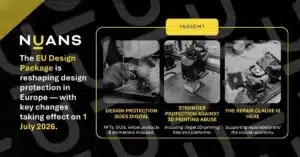

The EU Design Package
The design of a product can be of significant commercial value for companies. Think of luxurious furniture, designer fashion, the latest smartphone or trendy packaging for consumer goods. As society has become increasingly digital, existing design regulations no longer fully reflected technological developments. The EU Design Package (Regulation (EU) 2024/2822 and Directive 2024/2823) steeks to address this gap. As we approach the final phase of implementation of the rules for EU Designs on 1 July 2026, we highlight some of the key developments introduced by the Design Package.
From physical to virtual: a broader scope of protection
The most significant change of the Design Package concerns the definition of both “design” and “product.” Since the first phase of the reform entered into force in May 2025, design protection is no longer reserved for tangible objects: the new rules explicitly extend this protection to the digital sphere. Design protection can now also be granted to inter alia:
- NFTs;
- Virtual clothing and accessories used in virtual reality (‘VR’);
- Graphical user interfaces (GUIs);
- CAD files;
- …
In addition to static images, design protection is extended to dynamic features of a product. Movements, transitions and animations can now be registered as designs. This creates new opportunities for businesses seeking to protect, for example, animated logos in audiovisual productions or visual effects used in video games.
Although these forms of protection became available in principle as of May 2025, the EUIPO’s filing system was not yet technically adapted to accommodate them.. Applicants seeking protection for animated designs therefore still had to rely on a series of screenshots (up to seven images) to represent the movement.
As of 1 July 2026, any applicant will be able to submit modern digital file formats directly, such as MP4s.
The scope of design rights
With the rise of 3D printing technologies, it became easier for others to reproduce protected designs. The Design Package aims to tackle this issue for right holders. As a result, right shoulders can now take action not only against unlawfully 3D-printed objects but also against websites, platforms or software providers offering illegal 3D-printing files of protected designs.
At the same time, the reform introduces several important limitations to design rights. Right holders may no longer prevent third parties from referring to protected designs for purposes such as comparative advertising..
Furthermore, the use of a design for commentary, criticism or parody can no longer be prohibited, provided that such use complies with honest commercial practices and does not unreasonably prejudice the normal exploitation of the design.
The ‘repair clause’
While design protection plays an important role in safeguarding the commercial value of a product, it may sometimes conflict with sustainability objectives.. In particular, design rights could previously be used to prevent consumers from repairing damaged products using third-party spare parts.
After years of debate, the Design Package introduces a harmonised “repair clause” intended to address this issue. Under certain conditions, design protection no longer applies to visible component parts of a complex product where those parts are necessary to restore the product’s original appearance.
Although other forms of intellectual property protection, such as trademark law, may still impose certain restrictions, this reform represents an important step toward promoting repairability and supporting a more sustainable and circular economy.
Outlook
For the EU Designs, most of the substantive changes introduced by Regulation 2024/2822 already entered into force on 1 May 2025. The remaining provisions — primarily technical and procedural in nature — will become fully applicable on 1 July 2026. From that date onwards, applicants will effectively be able to file dynamic designs using modern digital formats such as MP4.
Meanwhile, Member States must transpose Directive 2024/2823 on national designs into their national legislation by 9 December 2027.
For any questions about design protection, feel free to contact our IP lawyers.