On 21 October 2026, Ellen Caen (Senior Associate) and Sander Vanderheyde (Partner) hosted the workshop “The EU AI Act for Builders: What Founders Really Need to Know” at Tectonic, held at the Wintercircus in Ghent. A practical blueprint for founders building with AI.
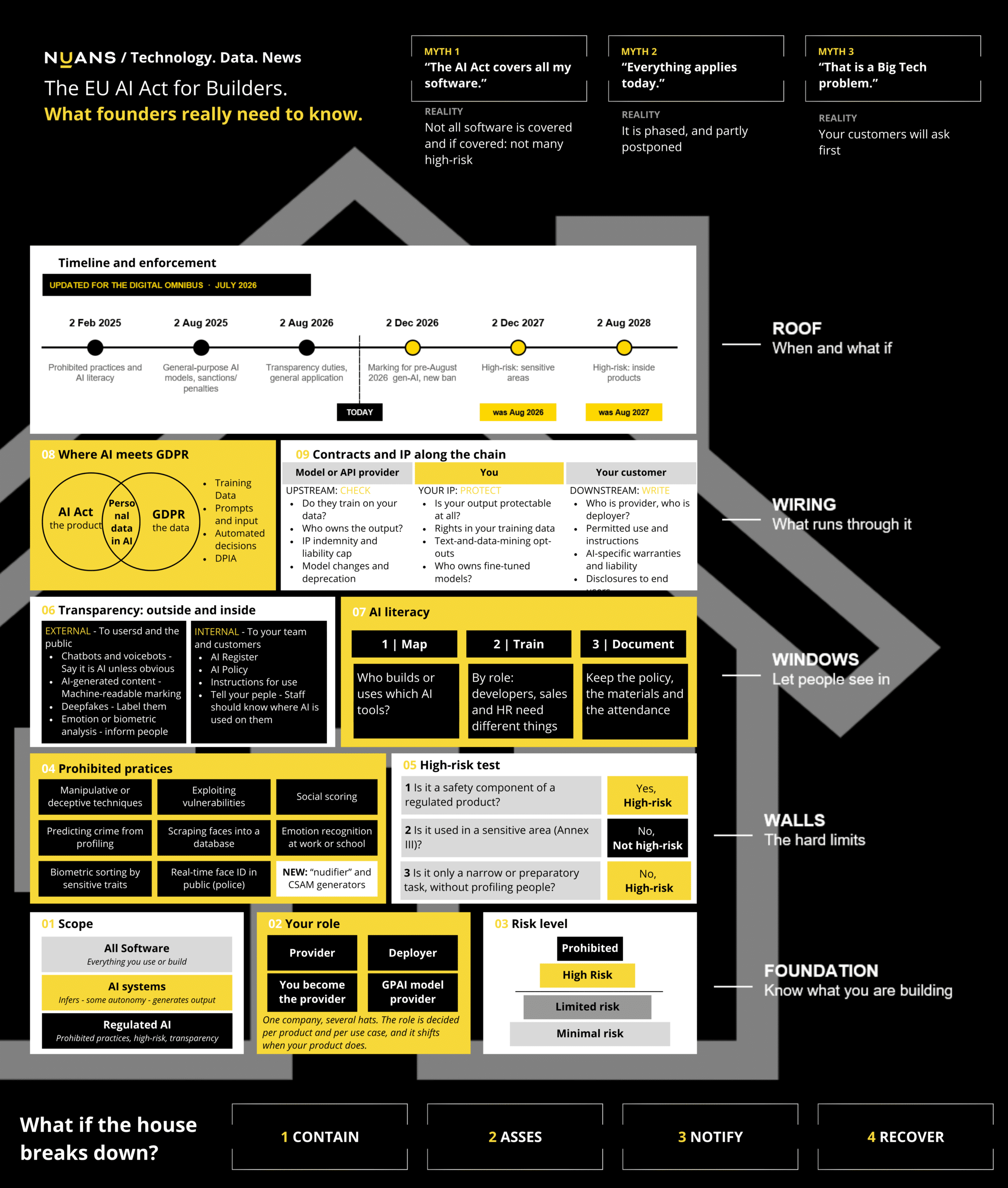
Many tech founders know that the AI Act exists, but few have actually read it. Understandably so: the legislation runs to over a hundred pages, and the Digital Omnibus of July 2026 has already introduced its first amendment. So we approached it the way founders build their products: step by step, using ten building blocks that together form one house.
First, clearing the construction site: three myths
- “The AI Act applies to all my software.” No. It only applies to AI systems (and general-purpose AI models), and most startup products fall into the lowest risk categories.
- “All the rules already apply today.” Not quite. The rules for high-risk AI have been postponed until December 2027 and August 2028.
- “That’s a Big Tech problem.” This is the most dangerous misconception. Startups, SMEs and small mid-caps do benefit from certain simplifications, such as simplified documentation, priority access to regulatory sandboxes and lower fines, but they are not exempt: the core obligations apply to them too. And the first person to ask you about AI Act compliance is rarely a regulator. More often, it’s your biggest customer, an investor or a potential acquirer.
The AI Act house: five layers
- The foundations: Is it actually an AI system? What role do you play (provider, deployer or something else)? And how risky is your application? Get this wrong, and everything you build on top will be on shaky ground.
- The walls: The hard boundaries. What is strictly prohibited, such as emotion recognition in the workplace, and whether your product qualifies as high-risk AI.
- The windows: Transparency towards users and AI literacy within your own team. The latter is the one obligation that applies to everyone.
- The wiring: What runs through your house. Data and GDPR compliance, as well as contracts with your model providers and customers.
- The roof: The timeline, fines and what happens if the roof starts leaking. Who is liable when an incident occurs, and how can you address that risk contractually?
Three startups, three dilemmas
During the interactive part of the workshop, the audience voted on three fictional startup cases: an HR tool predicting employee absenteeism, a system using facial recognition to grant workers access to construction sites, and a generative AI-powered marketing tool.
Each case raised the same questions: What role do you play? How high is the risk? And which feature requests from customers or investors are better left unanswered — or simply refused?
The answers surprised the audience more than once. Not everything involving facial recognition is high-risk, and not everything with an innocent-sounding name is permitted.
For most founders, the AI Act isn’t a showstopper. It’s a building code. Build compliance in from the start, and you’ll build faster and sell more easily.
Want to find out what your own AI Act house looks like? Get in touch with Nuans at hello@nuans-law.be.